

Voices of Impact 2026
How grantees and applicants experience Swiss grant-making foundations
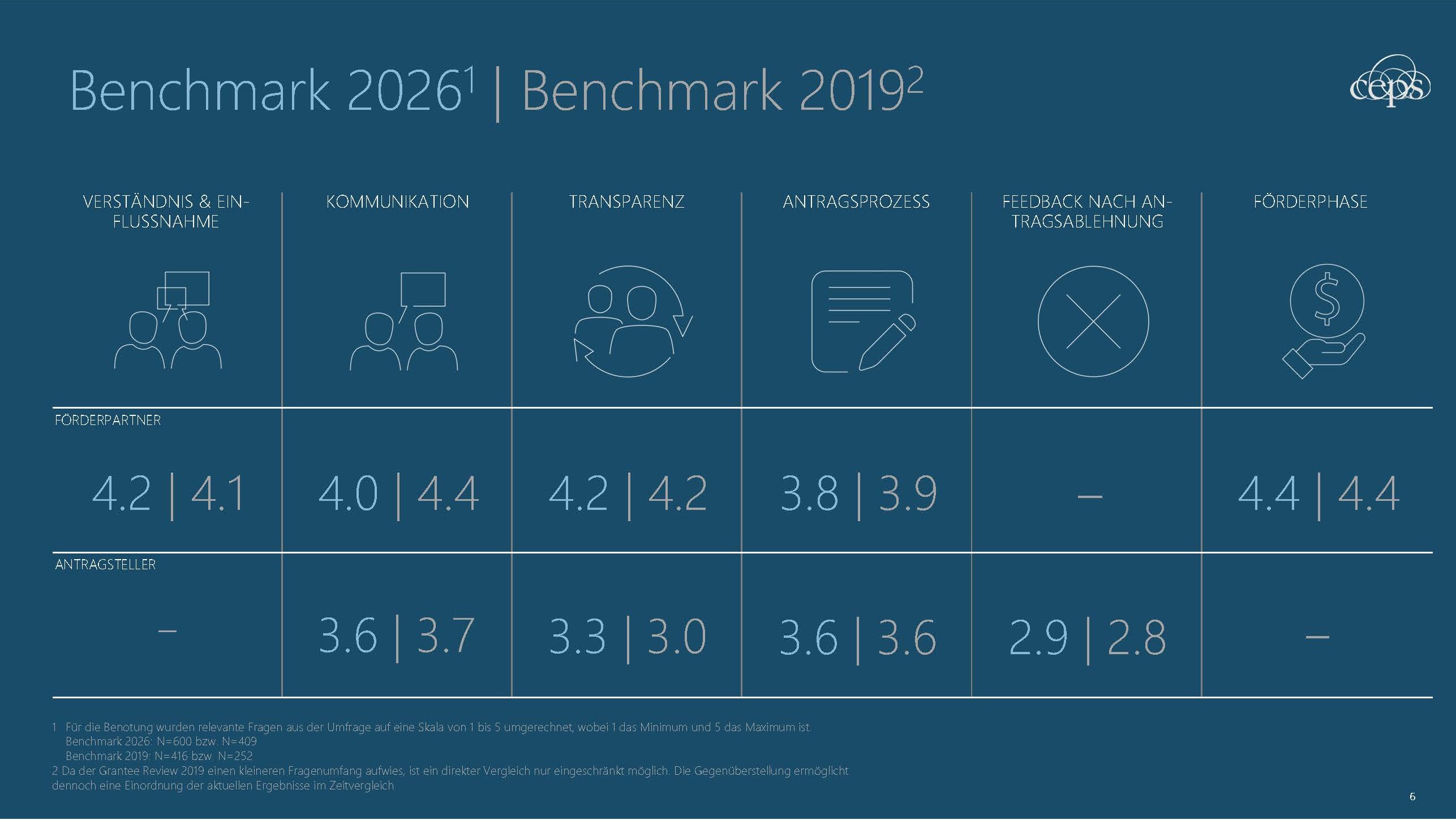
How do grantees and applicants perceive their foundations? What works well, and where is there room for improvement? These are the questions addressed by “Voices of Impact 2026”. The study by the Center for Philanthropy Studies (CEPS) at the University of Basel was carried out in collaboration with SwissFoundations. Following the Grantee Review Report 2019, it is the second large-scale survey of its kind in Switzerland.
Eight Swiss grant-making foundations took part. Responses from 600 grantees and 409 applicants were analysed. Topics included the foundations’ understanding of their partners’ field of activity, communication and transparency, application preparation, the funding phase and the handling of rejections.
What we learn from the “Voices of Impact” report
The Voices of Impact report offers unique insights into the often little-visible relationship between grant-making foundations and their grantees and applicants. Because the survey covers specific funding relationships, the results can be analysed separately for the experiences of grantees and of unsuccessful applicants. Here we have summarised six key recommendations for foundations, grantees and applicants:
1. Good funding starts with mutual understanding
Foundations, grantees and applicants bring different perspectives, expectations and experiences to the funding process. This is also reflected in how communication is rated: 97% of grantees experience it positively, compared with 63% of applicants.
A shared understanding of funding goals, expectations and framework conditions is therefore crucial. The more clearly each side knows what the other needs and expects, the more effectively resources can be used and the better suitable projects can be matched.
2. Personal exchange builds trust and better conditions for collaboration
75% of grantees were able to discuss their project personally with the foundation before applying, compared with only 25% of applicants. At the same time, those who had such a conversation rated the relationship considerably more positively, even after a rejection.
Personal exchange is therefore more than a service: it creates understanding, allows questions to be asked and helps both sides assess whether a project and a foundation are a genuine fit. Grantees and applicants should take up opportunities for exchange with foundations whenever possible.
3. Transparency makes funding more accessible and efficient
Only 48% of grantees and 30% of applicants know how the selection process works. At the same time, information sheets, websites and other support services are used relatively little.
Transparency is therefore not only a question of information, but also of efficiency and access. The better both sides know the criteria, procedure and timeframe for decisions, the more effectively they can use their resources.
Foundations can publish their funding criteria, exclusion criteria, process steps and timelines as concretely as possible and make their support services visible. Grantees and applicants should use this information before applying and thus avoid unnecessary applications. This increases the chance that scarce funding and everyone’s time are invested where there is a good fit.
4. A rejection can also be a valuable learning experience
A funding relationship does not begin only with an approval. 43% of applicants are not told the reasons for a rejection. At the same time, those who understand a rejection are considerably more satisfied with the foundation (72% compared with 26%).
Understandable feedback can therefore be valuable for both sides: applicants have the opportunity to learn from the experience and improve future applications. Foundations, in turn, gain insight into how their decision-making processes are perceived. In this way, even a rejection can become a constructive experience.
5. The right effort is not as little as possible, but as meaningful as possible
Grantees invest an average of 28 hours in preparing an application, applicants 21 hours. Around one third consider this effort too high. At the same time, 78% of grantees consider the average of 13 hours spent on reporting to be appropriate. Not every formal requirement is therefore seen as a bureaucratic burden. What matters is whether effort and benefit are in a reasonable relationship.
Foundations, grantees and applicants can work together to ensure that requirements match the size and complexity of a grant. Short preliminary enquiries, two-stage application procedures, clear templates or proportionate reporting can reduce the burden where additional effort does not create corresponding value. At the same time, a well-designed evaluation can add value: 57% of grantees say that reporting and evaluation helped to advance their project.
6. Trust means more autonomy and more shared learning
The study shows a remarkable combination: 94% of grantees feel heard and respected, and 73% experience a high degree of autonomy in implementing their projects. At the same time, 57% report that reporting and evaluation helped to advance their project.
Effective funding is therefore not simply about “giving money” or “receiving money”. It can create space for ownership, reflection, networking and learning. The report also shows that there is still potential for development: 32% of grantees have already experienced some form of involvement in the foundation’s strategic direction, while 68% have not. Where it fits their self-understanding, foundations can involve grantees and applicants earlier in strategy and programme development, for example through consultations, exchange formats or jointly developed funding programmes. Grantees and applicants, in turn, can actively contribute their practical knowledge and give feedback on funding processes.
The following grant-making foundations took part in the study:
- Age-Stiftung
- Arcanum Stiftung
- Fondation Leenaards
- Hasler Stiftung
- Hear the World Foundation
- Sophie und Karl Binding Stiftung
- Stiftung für Kunst, Kultur und Geschichte (SKKG)
- Stiftung Mercator Schweiz
- Linsi Foundation
- SwissFoundations
The report is available in German and French, with an executive summary in English.
If you are also interested in a corresponding analysis, please contact us.

Following the Grantee Review Report 2019, “Voices of Impact 2026” provides, for the second time in Switzerland, an assessment of the support provided by grant-making foundations from the perspective of their grantees. Grantees and applicants of eight grant-making foundations were surveyed.
Quick Links
Social Media